
Summary


LuminAI is an interactive art installation in which participants canengage in collaborative movement improvisation with an artificiallyintelligent virtual dance partner.
The line between human and non-human is blurred, spurringparticipants to examine their relationship with AI based technologyand how it can be expressive, social, and playful.
LuminAI is an interactive art installation in which participants can engage in collaborative movement improvisation with an artificially intelligent virtual dance partner.
The line between human and non-human is blurred, spurring participants to examine their relationship with AI based technology and how it can be expressive, social, and playful.


LuminAI’s virtual agent analyzes participant movements through procedural representations of the Viewpoints andLaban’s movement theory (from theater and dance) and improvises responses from transformed memories of pastinteractions with people. In other words, the agent learns how to dance by dancing with us.
Viewpoints
Laban’s


The LuminAI installation ultimately examines how humans and machines can co-create experiences together asequals, but it does so in a lighthearted environment. Participants are able to creatively explore movement whilehaving fun.





ON-GOING WORK
Engaging with the public in aninformal learning environments,as a way of increasing theunderstanding and awareness ofAI and computational literacy.
Investigating the Laban’smovement theory as a wayfor the agent to understandand reason about movement
Developing a machine learningtoolkit for visualizing how theagent clusters similar gesturestogether as it is learning
Source: https://adamlab.gatech.edu/projects/luminai/
Role




I am a Graduate Research Assistant in Dr. Brian Magerko’s Expressive Machinery Lab, working on the project. I amresponsible for imparting the learnings from Laban’s Movement Analysis to the AI. This includes:
Studying Laban’s MovementTheory to identify keys aspectsof human movement
Researching the variousadaptations of various LMAcomponents
Deriving computationalrepresentation of LMAcomponents being
Adopting the Laban basedcomputational modelsinto AI
Laban's Movement Theory






PARADIGMS
PARADIGMS
Body
Describes the body parts that are moving, are connected, are influenced by others, and general statement about organization.
Shape
The way the body changes shape during movement is further experienced and analyzed through the Shape category.
Effort
Effort describes the dynamic qualities of movement. It is intended towards understanding the inner intentions related to a movement
Space
Involves motion in connection with the environment, and with spatial patterns, pathways, and lines of spatial tension.
Source: Wikipedia

MOVEMENT QUALITIES
Efforts or Movement Qualities in Laban’s theory attempts to describe the dynamic qualities of human movement.These include qualities like how sudden a movement is, or how free a movement is, amongst others. Each of thesequalities are correspond to an inherent attitude, an innate nature. It is this innate nature that Laban tries to manifestthrough these qualities. There are 4 of these movement qualities which, in Laban’s Notation, are represented asfollows:
Weight
Space
Flow
Time



Laban’s notation for efforts
Time
Flow
Weight
Space
How heavy or light
the movement is.
Physiologically, it
relates to how much
energy is exerted in
movement
How free or bound the
movement is.
Physiologically it
relates to muscle
tension during the
movement
How direct or indirect
the movement is. This
relates to how focussed
the attention of a
performer is
How sudden or
sustained the movement
is. This is related to how
jerky the motion is
Laban’s notation for efforts
Space
How direct or indirect the movement is. This relates to how focussed the attention of a performer is
ATTENTION
You attend to an object
Weight
How heavy or light the movement is. Physiologically, it relates to how much energy is exerted in movement
INTENTION
You identify the intention of dealing with object
Time
How sudden or sustained the movement is. This is related to how jerky the motion is
DECISION
You choose, quickly or slowly, whether to pursue the decision
Flow
How free or bound the movement is. Physiologically it relates to muscle tension during the movement
PRECISION
You carry out the intended action with certain precision
Behind The Curtains
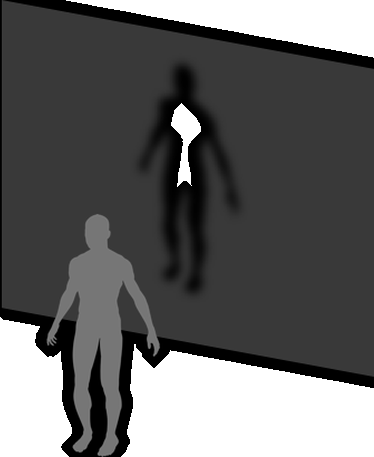
The virtual dance partner manifests itself as a shadow on thescreen in front of participants. This shadow tries to follow themovements of the participant - starting with imitation and thengoing into response mode. In response mode, the agent can doeither do random transformation on the same movement asthe participant, or recall a similar gesture from its memory.
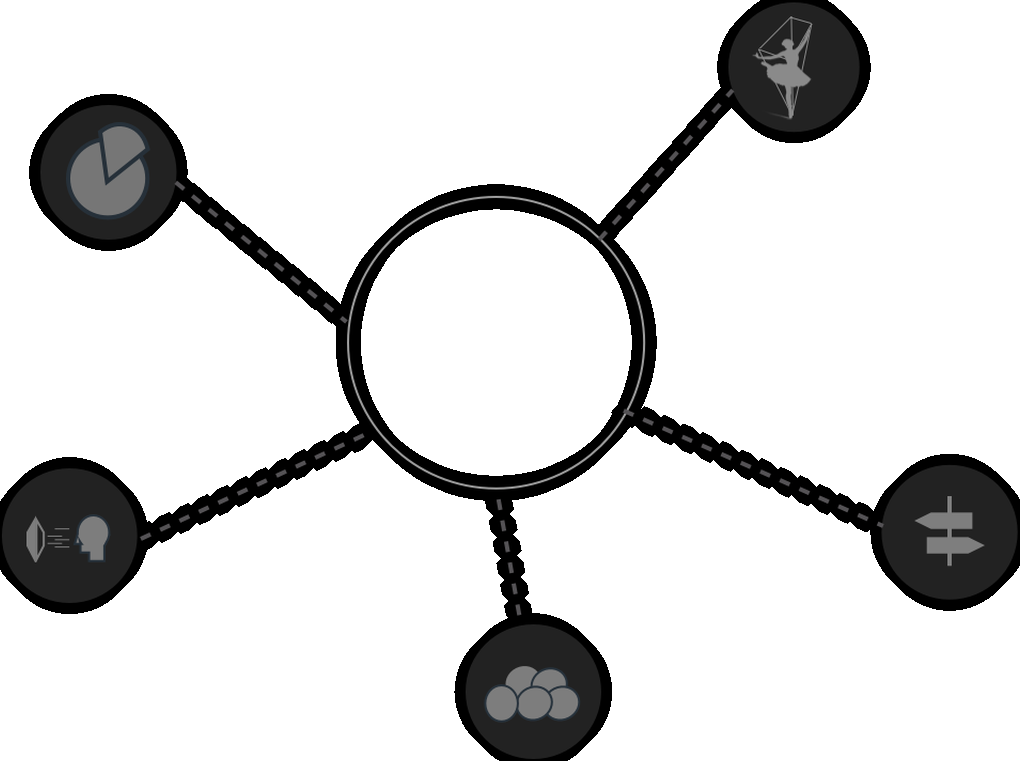
Movement
Theory
Gesture
Segmentation
LuminAI Core
Decision
Making
Visualization
Memory
Movement
Theory
Gesture
Segmentation
LuminAI Core
Decision
Making
Visualization
Memory