
SUMMARY


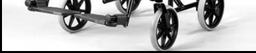
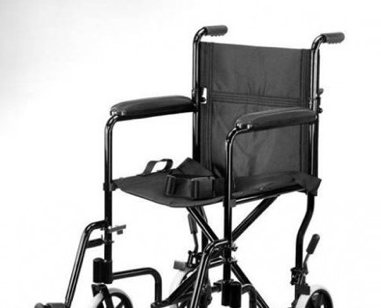
The Medline Steel Transport wheelchair is designed to transport people who have mobility limitations.
It has 2 distinct users:
People with
mobility limitation
Caregivers
Objective







Process
Identifyyour specificpopulation
Determine thekey parametersof the wheelchair.Measure them.
Refer anthropometric
databases to findcorrect ergonomicmeasures for chosen
population
Find mismatches
in design and
measurements
Suggest design
recommendations,
prioritization &
trade-offs
WHEELCHAIR DETAILS



Heuristics
Seat to back angle
Handle Diameter
Seat Angle




Handle Length
Backrest Height
Seat Depth
Push handle Height
Heuristics for
Wheelchair




Armrest Height
Seat Height
Seat Width
Distance between handles
USER GROUP


Population: American men & women
Range: 25th to 75th percentile
Measurements: CAESAR database (Civilian American and European Surface Anthropometry Resource )
In general, men had higher values of measure (for 25th, 50th as well as 75th percentile) as compared to women. Only for hip
width measure did women have higher values than men. Thus, for the current analysis, we choose:
25th
percentile
American woman
25th
percentile
American woman
75th
percentile
American man
75th
percentile
American man
Measures NOT involving Hip-Width
Measures involving Hip-Width
Population: American men & women
Range: 25th to 75th percentile
Measurements: CAESAR database (Civilian American and European Surface Anthropometry Resource )
In general, men had higher values of measure (for 25th, 50th as well as 75th percentile) as compared to women. Only for hip width measure did women have higher values than men. Thus, for the current analysis, we choose:
25thpercentileAmerican woman
75thpercentileAmerican man
Measures NOT involving Hip-Width
25thpercentileAmerican woman
75thpercentileAmerican man
Measures involving Hip-Width
ANALYSIS & RECOMMENDATIONS


Seat Width
We recommend the seat width to accommodate 75th percentile of women to include majority of people’s
hip width. Without making such changes, people may not be able to sit on the wheelchair, which is why wehave prioritized seat width to be the top priority to immediately implement our recommendation of43.67 cm.
Push handle Height
We recommend push handle height to be 110 cm to cover the 75th percentile female and 25th
percentile male. The current dimension is too low for the male elbow standing height and, as mentioned,
can risk a low back pain when pushing the wheelchair. Hence, like seat width, we assigned adjusting the
push handle height to a high priority.


Seat Height
The current seat height is too high to sit easily for the 75th female percentile. By decreasing the seat height,
it may be become too low for male with longer legs, which can cause discomfort when sitting down on
the seat surface. However, such discomfort does not exist after the user puts his or her feet on the
footrest, and thus, the priority is the lowest. The best trade-off would making the seat height adjustable to
42.5 cm to 52.2 cm as explained previously.
Armrest Height
We recommend the armrest height to be 21.5 cm to accommodate majority of target users and be higher
than female’s 75th percentile elbow sitting height. The current measurement is high and can cause
discomfort in the arms. This may apply to majority of the male population as seen from our calculation, and
thus, we have placed it in 4rd in the priority.


Seat Angle
We recommend the seat angle to be around 3 degrees, with a possible adjustment between 0 and 6
degrees as seen in a research paper [1]. The current seat angle of 6 degree, which is in the range, but if
possible, the seat angle should be around 3 degrees for the best comfort. The higher angle can increase the
pressure on buttocks after sitting for a long period, which is a small concern compared to the rest.
Distance between handles
We recommend distance to be 44 cm using shoulder breadth and concluding that the parameter value
should not be large so that users with small shoulder breadth won’t be obstructed. However, this relies on
users’ preference and the range is discovered to be between 40.56 cm to 51.95 cm, which does include
the current dimension. Hence, we assigned priority as the least.